Bacterial lineage tracing
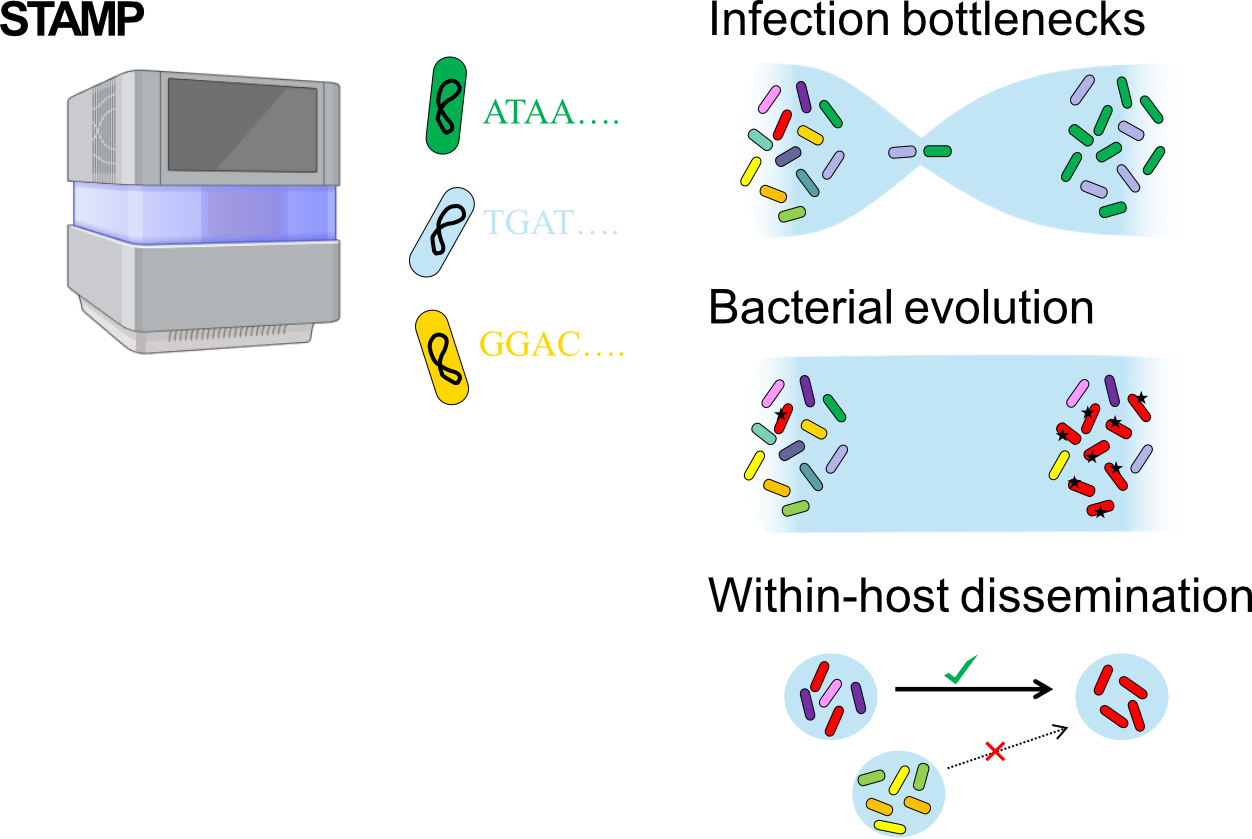
How many bacteria start an infection — and what determines whether a cell succeeds or is lost along the way? For a pathogen to colonize a new host, it must first pass through a series of bottlenecks: physical barriers, immune defenses, and competition from the resident microbiota that eliminates most invading cells before disease even begins. These bottlenecks are central to infection biology, but they are difficult to directly measure.
We study within-host bacterial populations using genomically encoded barcodes, so that every cell carries a unique, heritable tag. By sequencing which barcodes survive an infection we can reconstruct the size of the “founding population” that gave rise to an infection using a population modeling technique called STAMP (sequence tag-based analysis of microbial populations). Furthermore, by introducing heritable heterogeneity, bacterial-barcodes reveal previously unrecognized patterns of within-host bacterial evolution and dissemination.
Related publications:
Campbell† IW, Hullahalli† K, Waldor MK (2026). Quantifying host-microbe interactions with bacterial lineage tracing. Science 391(6780):34-40.
Hotinger† JA, Campbell† IW, Hullahalli K, Osaki A, Waldor MK (2025). Quantification of Salmonella enterica serovar Typhimurium population dynamics in murine infection using a highly diverse barcoded library. eLife 13:RP101388.
Campbell IW, Hullahalli K, Turner JR, Waldor MK (2023). Quantitative dose-response analysis untangles host bottlenecks to enteric infection. Nature Communications 14(1):456.
Within-host bacterial genetics
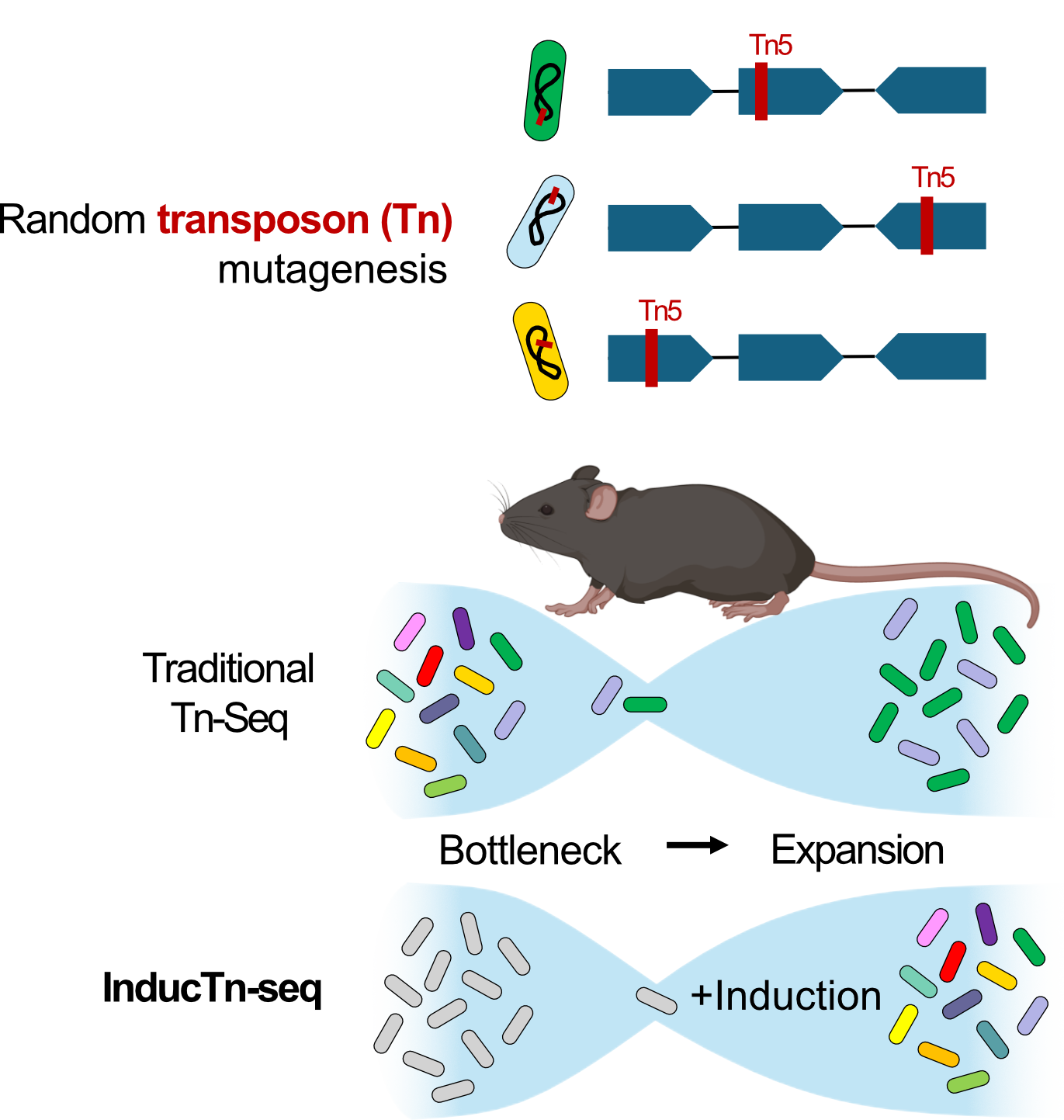
Which bacterial genes matter for survival inside a living host? Traditional genome-wide loss-of-function screens have been powerful tools for identifying the genes that bacteria need for survival in a flask, but they often fail in animals: the same host bottlenecks that limit infection also stochastically (randomly) cull most of the mutant pool before fitness can be determined. In other words, bacterial mutants can be lost from the population purely by chance, not because of the disrupted gene’s function.
We built InducTn-seq to get around this problem. Rather than mutagenizing bacteria before they enter a host — and letting the bottleneck eliminate that diversity before the experiment even starts — InducTn-seq uses an inducible transposon mutagenesis system to generate a new, pooled library of mutants within the host. InducTn-seq and related genetic tools have helped us to connect specific bacterial genes and environmental cues to colonization, immune evasion, and transmission between hosts.
Related publications:
Basta† DW, Campbell† IW, Sullivan EJ, Hotinger JA, Hullahalli K, Garg M, Waldor MK (2025). Inducible transposon mutagenesis identifies bacterial fitness determinants during infection in mice. Nature Microbiology 10(5):1171-1183.
Campbell† IW, Basta† DW, Zingl FG, Sullivan EJ, Doranga S, Waldor MK (2025). Anoxia activates CRISPR-Cas immunity in the mouse intestine. Nature Microbiology. PMID: 41162659.
Campbell† IW, Dehinwal† R, Morano AA, Dailey KG, Zingl FG, Waldor MK (2025). Vibrio cholerae motility is associated with inter-animal transmission. Nature Communications 16, 7989.